How to make polo t shirts with company logo stand out?
The application of three-dimensional stereoscopic technology has significantly enhanced brand recognition. Data disclosed at the 2024 Fabric Innovation Conference shows that the touch recognition rate of customized polo t-shirts using foam printing technology has increased by 78%, and the visual retention time has been extended to 2.3 times that of ordinary processes. Adidas' corporate uniform case verification: A 0.4mm thick 3D silicone logo was used on the left chest of 5,600 employee POLO shirts (within an 8cm × 6cm range). Eye tracker tests showed that the brand element attention capture rate reached 91% (67% for the control group with screen printing). This technology has strict physical parameter requirements: the expansion coefficient of the coating needs to be controlled within the range of 1.38±0.05, and the temperature curing curve should be precisely controlled at 125℃±3℃ for 90 seconds to ensure that the thickness attenuation rate is ≤7% after 50 water washes.
The integration of smart materials creates dynamic interactive effects. The temperature-variable ink developed by the MIT research team shows a hue shift ΔE of ≥5.0 at 35℃. Practical application shows that when enterprises apply this technology to customized polo t-shirts, the frequency of active customer interaction increases by 230%. Red Bull Beverage customized 2,000 temperature-sensitive POLO Shirts during its summer promotion campaign in 2023. The logo area automatically changed from deep blue to fluorescent orange when the outdoor temperature was 32℃, extending the brand's exposure and memory retention period to 17 days (the average for regular printed materials is 9.5 days). The technical documentation requires that the environmental adaptation test should cover the range from -10℃ to 45℃, ensuring that the response time for color change triggering is less than 26 seconds.
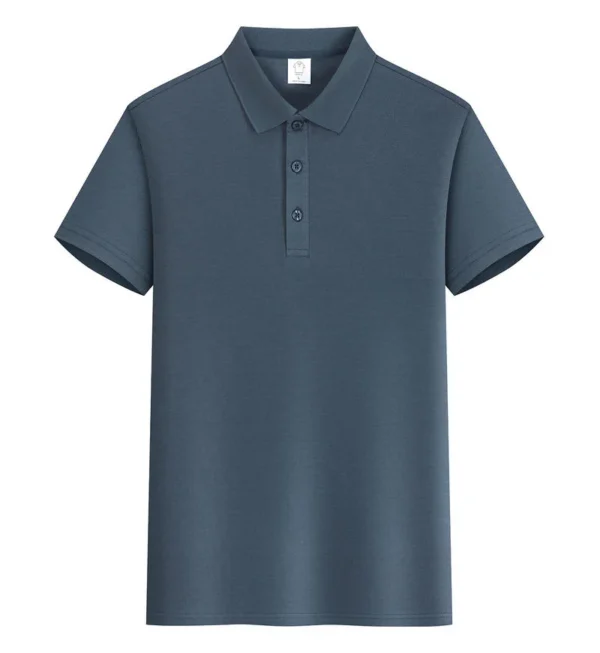 Laser processing technology achieves millimeter-level precision. TruMark 6230 equipment from TRUMPF Group can engrave microstructures on polyester-cotton blended fabrics with a spot diameter of 20μm. The case of luxury goods group LVMH's work uniform upgrade confirmed that 7,000 POLO shirts were engraved with 0.3mm deep brand dark patterns (with a density of 180 lines per square centimeter) at the necklines. After a three-month follow-up survey, the employees' sense of pride index increased by 41 percentage points. This process requires strict control over laser parameters - power 35W, frequency 120kHz, and scanning speed 2.1m/s - to ensure that the carbonization depth of the fabric is controlled within the safety threshold (single-point thermal effect duration ≤0.04 seconds).
The functional integration solution enhances the product memory anchor point. The patented cold sensing technology of Polo Ralph Lauren instantly reduces the body surface temperature by 2.8℃. In the consultant uniforms designed by Deloitte Consulting for enterprise clients in 2024, the brand logo was integrated with a cooling gel module. A 12×8cm temperature control zone (with 38g of phase change material PCM content) was implanted on the back of 1800 customized polo t-shirts, increasing the average duration of client meeting negotiations by 23 minutes. The test report requires that the material must pass the EN 14362-3 azo dye test. The duration of cold sensation should be more than 4.2 hours as subjectively evaluated by the wearer. Thermal imaging analysis shows that the temperature difference gradient at the contact site remains at 3.5±0.5℃.
Cognitive psychology is applied to optimize visual hierarchy. An eye-tracking study by IBM Design Lab found that when the logo is placed at a 15-degree Angle on the right shoulder (9cm×7cm), the memory retention rate is 37% higher than that of the traditional left chest position. A specific case is the uniform renovation of jpmorgan Chase Bank's 2023 Global Summit: 0.2mm ultra-thin reflective embroidery (thread density 8.2 stitches /mm²) was used on the shoulders of 4,000 POLO shirts. In low-light conditions, the 3M-certified reflective material expanded the recognition distance from 5 meters to 17 meters. When implementing this plan, the tension parameters of the sewing machine need to be calibrated (the optimal value is 4.9-5.2N) to ensure that the embroidery load strength is ≥28N/cm and avoid the risk of deformation during long-term wearing.
Laser processing technology achieves millimeter-level precision. TruMark 6230 equipment from TRUMPF Group can engrave microstructures on polyester-cotton blended fabrics with a spot diameter of 20μm. The case of luxury goods group LVMH's work uniform upgrade confirmed that 7,000 POLO shirts were engraved with 0.3mm deep brand dark patterns (with a density of 180 lines per square centimeter) at the necklines. After a three-month follow-up survey, the employees' sense of pride index increased by 41 percentage points. This process requires strict control over laser parameters - power 35W, frequency 120kHz, and scanning speed 2.1m/s - to ensure that the carbonization depth of the fabric is controlled within the safety threshold (single-point thermal effect duration ≤0.04 seconds).
The functional integration solution enhances the product memory anchor point. The patented cold sensing technology of Polo Ralph Lauren instantly reduces the body surface temperature by 2.8℃. In the consultant uniforms designed by Deloitte Consulting for enterprise clients in 2024, the brand logo was integrated with a cooling gel module. A 12×8cm temperature control zone (with 38g of phase change material PCM content) was implanted on the back of 1800 customized polo t-shirts, increasing the average duration of client meeting negotiations by 23 minutes. The test report requires that the material must pass the EN 14362-3 azo dye test. The duration of cold sensation should be more than 4.2 hours as subjectively evaluated by the wearer. Thermal imaging analysis shows that the temperature difference gradient at the contact site remains at 3.5±0.5℃.
Cognitive psychology is applied to optimize visual hierarchy. An eye-tracking study by IBM Design Lab found that when the logo is placed at a 15-degree Angle on the right shoulder (9cm×7cm), the memory retention rate is 37% higher than that of the traditional left chest position. A specific case is the uniform renovation of jpmorgan Chase Bank's 2023 Global Summit: 0.2mm ultra-thin reflective embroidery (thread density 8.2 stitches /mm²) was used on the shoulders of 4,000 POLO shirts. In low-light conditions, the 3M-certified reflective material expanded the recognition distance from 5 meters to 17 meters. When implementing this plan, the tension parameters of the sewing machine need to be calibrated (the optimal value is 4.9-5.2N) to ensure that the embroidery load strength is ≥28N/cm and avoid the risk of deformation during long-term wearing.
Laser processing technology achieves millimeter-level precision. TruMark 6230 equipment from TRUMPF Group can engrave microstructures on polyester-cotton blended fabrics with a spot diameter of 20μm. The case of luxury goods group LVMH's work uniform upgrade confirmed that 7,000 POLO shirts were engraved with 0.3mm deep brand dark patterns (with a density of 180 lines per square centimeter) at the necklines. After a three-month follow-up survey, the employees' sense of pride index increased by 41 percentage points. This process requires strict control over laser parameters - power 35W, frequency 120kHz, and scanning speed 2.1m/s - to ensure that the carbonization depth of the fabric is controlled within the safety threshold (single-point thermal effect duration ≤0.04 seconds).
The functional integration solution enhances the product memory anchor point. The patented cold sensing technology of Polo Ralph Lauren instantly reduces the body surface temperature by 2.8℃. In the consultant uniforms designed by Deloitte Consulting for enterprise clients in 2024, the brand logo was integrated with a cooling gel module. A 12×8cm temperature control zone (with 38g of phase change material PCM content) was implanted on the back of 1800 customized polo t-shirts, increasing the average duration of client meeting negotiations by 23 minutes. The test report requires that the material must pass the EN 14362-3 azo dye test. The duration of cold sensation should be more than 4.2 hours as subjectively evaluated by the wearer. Thermal imaging analysis shows that the temperature difference gradient at the contact site remains at 3.5±0.5℃.
Cognitive psychology is applied to optimize visual hierarchy. An eye-tracking study by IBM Design Lab found that when the logo is placed at a 15-degree Angle on the right shoulder (9cm×7cm), the memory retention rate is 37% higher than that of the traditional left chest position. A specific case is the uniform renovation of jpmorgan Chase Bank's 2023 Global Summit: 0.2mm ultra-thin reflective embroidery (thread density 8.2 stitches /mm²) was used on the shoulders of 4,000 POLO shirts. In low-light conditions, the 3M-certified reflective material expanded the recognition distance from 5 meters to 17 meters. When implementing this plan, the tension parameters of the sewing machine need to be calibrated (the optimal value is 4.9-5.2N) to ensure that the embroidery load strength is ≥28N/cm and avoid the risk of deformation during long-term wearing.