How Miners Fund Electricity Bills Without Selling BTC
A 10 PH/s fleet of 20 J/TH machines draws 200 kW, or 4,800 kWh a day, which costs about $288 a day at $0.06 per kWh — roughly $8,640 a month, or about 0.102 BTC at the read-date price of $84,692. Gross mining income at the same moment is about 0.00449 BTC a day, and how you move that income onto the utility's schedule is a cash-flow decision with three legitimate answers.
Key takeaways
- At 10 PH/s with 20 J/TH hardware, power costs about $8,640 a month at $0.06 per kWh, against roughly $11,398 of gross monthly income at the read-date price — power is close to three quarters of gross revenue.
- Pledging coins against a loan is the route that keeps the BTC position intact; selling mined coins is the route that has no repayment schedule attached. Both change what you hold, in opposite directions.
- Payment cadence decides how much of the bill you can cover from production rather than reserves: at 1 PH/s, hourly settlement credits about 0.0000187 BTC — roughly $1.58 — every hour.
- No funding method changes expected mining income, which depends on your share of network hashrate and current difficulty. Difficulty moves both ways: the read-date estimate was −2.12%.
Context in 2026
Post-halving economics leave less room for improvisation. With a 3.125 BTC subsidy and 144 blocks a day, the network issues 450 BTC daily — about $38.1 million at $84,692 — and that pool of value is split across a network hashrate near 1,003 EH/s. For a mid-sized operation, the interesting question is no longer whether mining is profitable in the abstract but whether the fleet can be run without a forced sale in a bad week.
A forced sale is expensive in a way that rarely appears in a mining calculator: coins sold to cover a February electricity bill are not there for a repricing later, and the decision is made at the worst possible moment — when difficulty has risen or the fleet is underperforming.
The two variables that matter
The first variable is settlement cadence: how quickly mined coins become spendable. PPS+ settles the block-reward component per share at current difficulty with a listed 4% fee and pays hourly, while PPLNS applies a listed 2% fee to block rewards and transaction fees together but distributes only after a block receives 6 confirmations, over a trailing window of 5 difficulty rounds.[1]
The second variable is what you are willing to pledge. Funding a bill from production keeps the balance sheet static. Funding it with a ViaBTC Crypto Loan keeps the coins but adds a repayment schedule: collateral added, loan applied for, funds disbursed, obligation repaid, collateral redeemed.[2]
| Approach | How it works | Effect on the BTC position | Main risk |
|---|---|---|---|
| Pay from hourly settlement | Mined coins land hourly and accumulate against the bill | Position grows steadily; nothing pledged | Income arrives in coin, the bill in fiat — the conversion timing is yours |
| Hold a two-month buffer | Accumulate a balance equal to two billing cycles, then draw down | Position intact after the buffer is built | Requires patience before the buffer exists |
| Collateral-pledged loan | Pledge held coins, receive liquidity, repay from production | Coins retained; obligation added | Repayment must come from income, and collateral value moves with the market |
| Sell mined coins monthly | Convert production to fiat as the bill arrives | Accumulation effectively stops for that month | Coin held long term is reduced at the price of the day |
Numbers from a real rig
Use the 10 PH/s fleet. Its gross daily income is 0.00449 BTC, about $379.93; the listed 4% fee on the block-reward component leaves roughly $364.73. Power is 4,800 kWh a day, $288 at $0.06 per kWh. The operating spread is therefore about $76 a day, or roughly $2,300 a month before hosting and capital costs.
Against that spread, a single month's bill is 0.102 BTC at the read-date price — 24% of monthly production, which is why a short settlement cadence is worth more than it looks. Hourly settlement credited at 0.0000187 BTC per hour at 1 PH/s means the bill is being funded continuously rather than in one lump at the end of the month.
The alternative is visible in the same numbers. Borrowing against 0.1 BTC of collateral to pay a bill and repaying it across the following weeks from production leaves the coin stack untouched — but the repayment is still a real transfer of mined value, and it happens on the loan's schedule rather than the utility's. In both cases the fleet's output is what ultimately pays, and the fleet's output depends on difficulty and effective hashrate, not on the instrument.
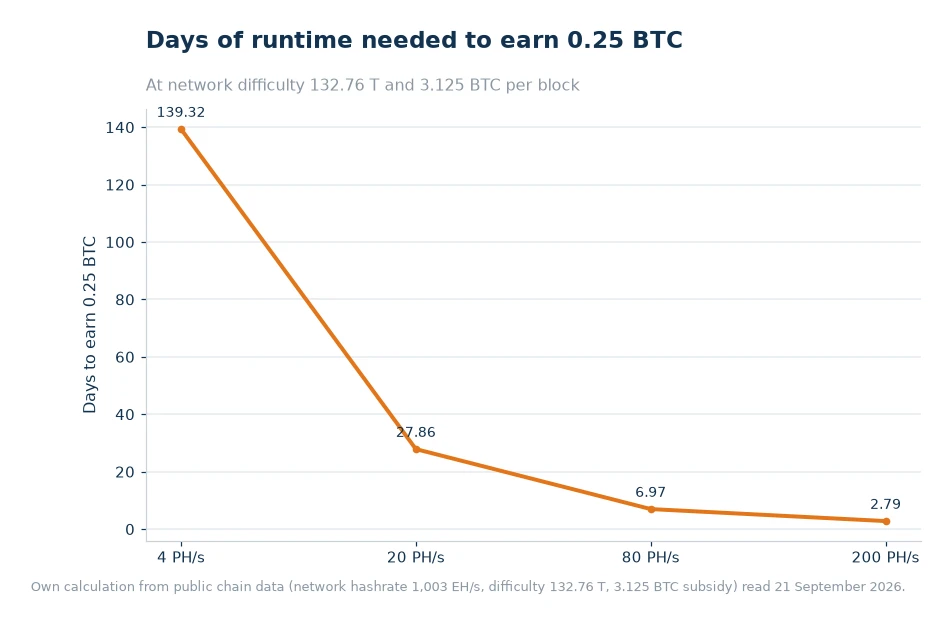
The chart reframes an obligation as a duration. A 0.25 BTC figure — a plausible quarter of collateral — takes about 139 days to earn back at 4 PH/s, about 28 days at 20 PH/s, and under three days at 200 PH/s. Sizing any funding decision against that column is far more useful than comparing headline rates: it tells you how many months of normal operation the commitment represents.
Decision guide
- Start with cadence, not with instruments. If payout frequency is already shorter than your billing cycle, the funding problem is arithmetic rather than structural.
- Keep the rails in one account. Mining payouts, conversion and balances in a single account remove transfer steps that each cost time and fees; zero-fee mining payouts make small, frequent withdrawals practical.
- Only pledge coins you can leave pledged. Collateral is not a reserve if you need it back next month.
- Model the repayment from production at current difficulty. Then re-run it with per-share income 5% lower and confirm the plan still holds.
- Check the fleet before the market. A machine that no longer clears its electricity cost is a bigger drain than any funding choice; profitability ranking pages exist to make that visible per model.
- Recheck monthly. Settlement history, effective hashrate and difficulty are all readable per coin from a hourly mining payouts statistics view.
The simplest version of all of this remains the least glamorous: run a mining pool that settles hourly, keep the earnings where you can see them, and let a two-month buffer absorb the months when difficulty and temperature move against you. If mining payouts reach the same account that holds your collateral, borrowing becomes an emergency tool rather than a monthly habit.
Frequently asked questions
Does the payout method change my average income?
It changes the variance and the fee, not the underlying expected value: your share of network hashrate still sets the ceiling.
How often should a miner check pool statistics?
Weekly is enough for cash flow, daily if you are reconciling worker uptime or chasing a hashrate fault.
Can a loan replace mining income?
No. Expected income depends on your share of network hashrate and current difficulty. A collateral-pledged loan moves the timing of a payment and adds a repayment obligation; it does not add production.
What is the simplest way to cover a power bill from mining?
Match payout cadence to the billing cycle first. Hourly settlement credited into an account you control, held against a two-month buffer, covers most bills without selling coins or pledging them.
The short version
Match the funding schedule to the billing schedule first, because most electricity problems are timing problems. If the gap persists, compare the four approaches in the table: a buffer built from hourly settlement, a collateral-pledged loan, monthly selling of production, or a combination. Whichever you choose, keep the obligation measured in days of fleet output, not in headline amounts — that is the number that decides whether the plan survives a bad month.
Data and sources: ViaBTC fee schedule and payout documentation[1] and ViaBTC collateral-pledged loan documentation[2]. Network hashrate, difficulty, subsidy and BTC price read from public chain data on 21 September 2026. Figures are illustrative, exclude loan terms, and are not investment advice.